Modern interior design isn’t about cold, sterile minimalism or spending a fortune on designer furniture. It’s a design philosophy rooted in clean lines, functional spaces, and intentional choices that make a home work better for the people living in it. Whether you’re planning a full renovation or updating a single room, understanding the core principles of modern design helps you create a space that feels both current and livable. This guide breaks down practical strategies, material choices, and DIY-friendly updates to bring modern design into your home without breaking your budget or your back.
Table of Contents
ToggleKey Takeaways
- Modern home interior design prioritizes clean lines, functional spaces, and intentional material choices over expensive designer pieces, making it accessible for any budget.
- Floating furniture, minimal ornamentation, and large-format tiles are signature techniques that define modern interior design and create open, visually expanded rooms.
- Built-in storage, layer lighting with dimmers, and neutral color foundations with strategic accent colors form the backbone of timeless modern design schemes.
- Budget-friendly DIY updates like painting trim the same color as walls, upgrading cabinet hardware, and installing floating shelves deliver immediate modern design impact without hiring contractors.
- Modern kitchens succeed through workflow efficiency, integrated flat-panel cabinetry, large-format backsplash tiles, and seamless appliance design that eliminates visual clutter.
- Natural materials like wood, stone, and glass in light-to-medium tones and matte finishes define modern bedrooms and living spaces that feel contemporary and calm.
What Defines Modern Interior Design?
Modern design emerged in the early-to-mid 20th century as a reaction against ornate, heavily decorated Victorian interiors. The movement prioritized function, simplicity, and honest use of materials, think Frank Lloyd Wright’s open floor plans and the Bauhaus school’s “form follows function” mantra.
Today’s modern interiors share these characteristics:
- Clean, horizontal and vertical lines rather than ornate curves
- Open floor plans that connect living, dining, and kitchen spaces
- Minimal ornamentation, no crown molding, elaborate trim, or fussy details
- Neutral color palettes with bold accent colors used sparingly
- Natural materials like wood, stone, metal, and glass
- Large windows and abundant natural light
- Functional furniture with simple geometric forms
Modern design differs from contemporary design (which refers to whatever’s currently trendy) and mid-century modern (a specific 1950s-60s aesthetic). True modern design is timeless because it’s built on proportion, not fashion.
One key distinction: modern interiors embrace technology and newer materials. You’ll see polished concrete floors, steel beams left exposed as design elements, and frameless glass partitions. If you’re working with an older home, achieving a modern look often means removing layers, stripping painted woodwork, pulling down drop ceilings, or eliminating unnecessary walls (check for load-bearing structure first and consult a structural engineer before removing any wall).
Minimalist Living Rooms with Maximum Impact
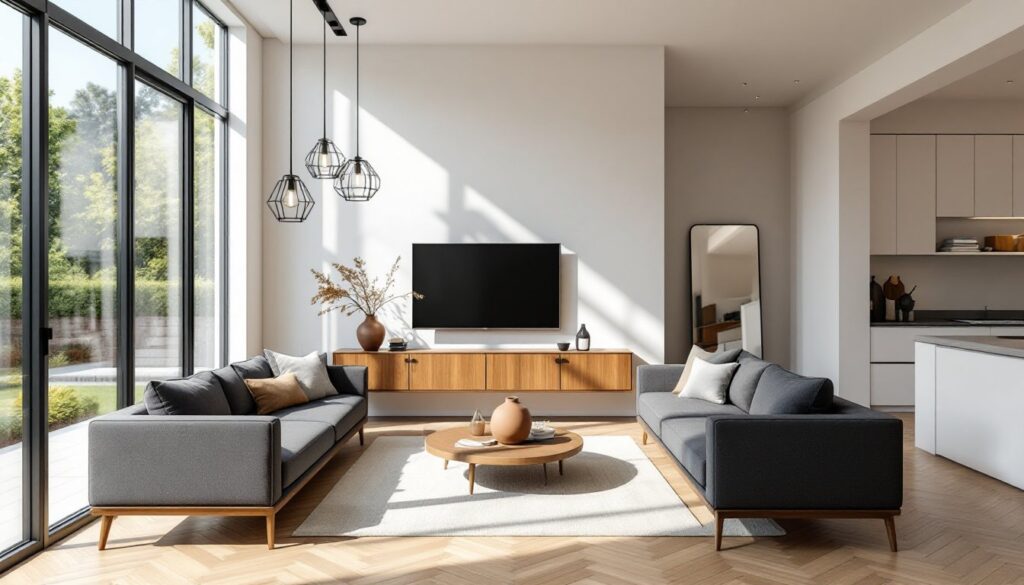
A modern living room succeeds when every piece serves a purpose and the space feels open, not empty.
Furniture layout: Start by floating furniture away from walls. A sofa positioned 12-18 inches from the wall creates better traffic flow and defines the seating area. Choose low-profile pieces with exposed legs, this lifts furniture visually and makes rooms feel larger. A sectional works well in open-plan homes, but stick to clean-lined models without rolled arms or skirts.
Storage solutions: Built-in shelving beats freestanding bookcases in modern spaces. If you’re handy with a circular saw and level, you can install floating shelves using heavy-duty concealed brackets rated for 50+ lbs. Use 3/4-inch plywood or solid hardwood cut to size, and anchor into wall studs for safety. Keep displays minimal, a few sculptural objects beat a crowded collection.
Window treatments: Skip heavy drapes. Install simple roller shades, sheer panels on ceiling-mounted tracks, or go bare if privacy allows. For DIY installation, measure carefully and use a laser level to ensure your mounting brackets sit perfectly horizontal.
Flooring: Hardwood, polished concrete, or large-format tile (24×24 inches or bigger) all work. If you’re laying new flooring, consider geometric home patterns in tile or luxury vinyl plank arranged in a herringbone or linear pattern.
Lighting: Layer three types: ambient (recessed cans or track), task (reading lamps), and accent (picture lights or LED strips). Dimmer switches are essential, install them on all overhead fixtures. A basic dimmer swap takes 15 minutes and requires only a screwdriver and wire stripper.
Smart Kitchen Design for Contemporary Homes
Modern kitchens prioritize workflow efficiency and clean surfaces. The classic work triangle (sink, stove, refrigerator) still applies, but today’s designs emphasize uninterrupted counter runs and integrated appliances.
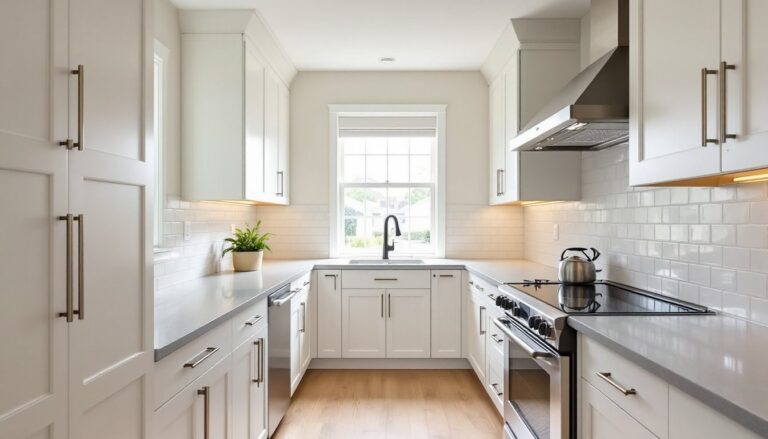
Cabinetry: Flat-panel (slab) doors in matte or high-gloss finishes define the modern kitchen. Skip ornate hardware, many modern cabinets use touch-latch mechanisms or simple horizontal pulls. If you’re refacing existing cabinets, replace raised-panel doors with slab-style replacements. Make sure new doors match the existing face frame dimensions (typically 3/4 inch for frameless, 1-1/2 inches for face-frame construction).
Countertops: Quartz offers the best blend of durability and low maintenance for modern kitchens. Waterfall edges (where the counter material continues down the side of an island) create a sculptural effect but require precision cutting, hire a fabricator for this detail. Standard countertop thickness is 3 cm (about 1-1/4 inches): going thicker to 6 cm adds visual weight.
Backsplash: Large-format tiles (12×24 inches or bigger) with minimal grout lines keep things sleek. White subway tile still works but is becoming ubiquitous, consider a solid slab backsplash in the same material as your counters, or a single sheet of back-painted glass. Installing glass requires silicone adhesive and a perfectly flat, primed wall surface.
Appliances: Panel-ready models that accept cabinet fronts create a seamless look. For small home renovation budgets, stainless steel appliances in matching finishes (brushed, not fingerprint-magnet polished) achieve a cohesive appearance without custom panels.
Lighting: Under-cabinet LED strips eliminate shadows on work surfaces. Hardwire them during a remodel, or use plug-in versions with a cord channel routed along the underside of wall cabinets.
Creating a Modern Bedroom Retreat
Modern bedrooms lean toward simplicity and calm, the opposite of cluttered, overstuffed traditional bedrooms.
Bed and furniture: Platform beds with low profiles and no footboard epitomize modern style. Many eliminate the box spring entirely, using slats or a solid platform base. If you’re building a DIY platform bed, use 2×6 or 2×8 lumber for the frame and 1×4 slats spaced 2-3 inches apart for proper mattress support and airflow.
Nightstands should be simple, floating wall-mounted units or slim tables with one or two drawers. According to design experts at Dwell, matching bedroom furniture sets read as outdated: mixing materials (a wood bed with metal nightstands, for example) feels more curated.
Closet systems: Exposed clothing racks or minimalist closet systems with adjustable shelving replace bulky wardrobes. If you’re installing closet organizers, measure carefully and use a stud finder to anchor heavy-duty shelving brackets. Standard closet rod height sits at 66 inches for long hanging, 42 inches for the upper rod in double-hang configurations.
Window coverings: Blackout roller shades or cellular shades provide light control without visual weight. Motorized options integrate with smart home systems but add cost, a quality manual shade works just as well functionally.
Color and texture: Stick to neutral walls (white, gray, taupe) and layer texture through bedding, rugs, and a single accent wall. Timeless home design principles suggest avoiding trendy wall colors that date quickly.
Color Palettes and Materials That Define Modern Style
Base neutrals: Modern interiors start with a neutral foundation, white, gray, beige, or black. These aren’t boring: they’re canvases. Paint finishes matter: use flat or matte on walls to minimize imperfections, eggshell in high-traffic areas for cleanability, and semi-gloss on trim (though many modern interiors skip trim altogether or paint it the same color as walls to eliminate visual breaks).
Accent colors: Introduce color through furniture, art, or a single accent wall. Modern palettes favor saturated, pure hues, navy, charcoal, olive, terracotta, or mustard, over pastels or muddy tones. The 60-30-10 rule works well: 60% dominant neutral, 30% secondary color, 10% accent.
Wood tones: Light to medium woods (oak, ash, walnut) appear in flooring and furniture. Avoid red-toned woods like cherry or mahogany, they skew traditional. If you’re refinishing hardwood floors, skip dark stains: natural or light gray-toned finishes feel more current. A standard floor refinishing involves sanding (use a drum sander for large areas, an edger for perimeters), applying stain if desired, and three coats of polyurethane. Rent equipment and budget 3-4 days for a typical 12×15 room.
Metal finishes: Matte black, brushed nickel, and unlacquered brass work in modern spaces. Match metal finishes within a room, mixing too many reads as chaotic. Replace dated hardware on cabinets and doors for an instant update: modern pulls typically mount on 3-inch or 5-inch centers (measure your existing holes before buying).
Stone and tile: Large slabs with minimal veining (think honed marble or solid quartz) beat busy granite patterns. For tile, consider 24×24-inch or 12×24-inch formats. Grout lines should be 1/8 inch or smaller for a sleek look, which requires tiles with rectified edges. Interior designers at MyDomaine frequently recommend neutral tile with contrasting grout for subtle visual interest without pattern overload.
Budget-Friendly Modern Design Updates You Can DIY
You don’t need a gut renovation to shift toward modern design. These projects deliver impact without requiring a permit or a contractor.
Paint everything one color: The fastest way to modernize any room is painting walls, trim, and ceiling the same shade of white or light gray. This eliminates visual clutter and makes spaces feel larger. Use a paint sprayer for speed (HVLP models work well indoors) or high-quality rollers with 3/8-inch nap for smooth walls. One gallon covers roughly 350-400 square feet.
Remove upper cabinets: In kitchens, pulling down a section of upper cabinets and installing open shelving opens sight lines. This is a straightforward demolition job, turn off power to any outlets in the cabinets, unscrew the cabinet boxes from wall studs, and patch/paint. Install shelving brackets rated for the load: dishes and glassware add up fast.
Update light fixtures: Swap dated chandeliers or flush-mounts for simple pendant lights or geometric fixtures. Most swaps require only basic wiring skills, turn off the breaker, disconnect the old fixture, connect black to black and white to white on the new fixture, and attach the ground wire. Always verify power is off with a non-contact voltage tester before touching wires.
Install floating shelves: These work in living rooms, bedrooms, or bathrooms. Use concealed bracket systems for a clean look. Locate studs with a stud finder, mark level lines, and use 3-inch wood screws into studs for maximum support. For shelves over 36 inches, use at least three brackets.
Refinish or paint furniture: Mid-century modern furniture from thrift stores often needs only cleaning and minor repair. Strip old varnish with citrus-based stripper, sand smooth (120-grit followed by 220-git), and apply Danish oil or a matte polyurethane. If painting, use a bonding primer and several thin coats of satin or semi-gloss paint.
Upgrade cabinet hardware: Swapping knobs and pulls takes an hour and costs $50-150 for an average kitchen. Choose simple bar pulls in brushed nickel or matte black. If new hardware doesn’t match old hole spacing, fill old holes with wood filler, sand, touch up paint, and drill new holes using a template jig for consistent placement.
Add a statement mirror: A large, frameless or simple-framed mirror leans against a wall or hangs horizontally to expand space visually. Ensure proper anchoring, mirrors are heavy. Use heavy-duty picture hangers rated for the weight, and anchor into studs when possible.
Conclusion
Modern interior design rewards careful editing and thoughtful material choices over decorative excess. By focusing on clean lines, functional layouts, and quality over quantity, homeowners can create spaces that feel both current and comfortable. Start with one room, master the principles, and expand from there, modern design is as much about what you leave out as what you put in.